Launch is not the finish line
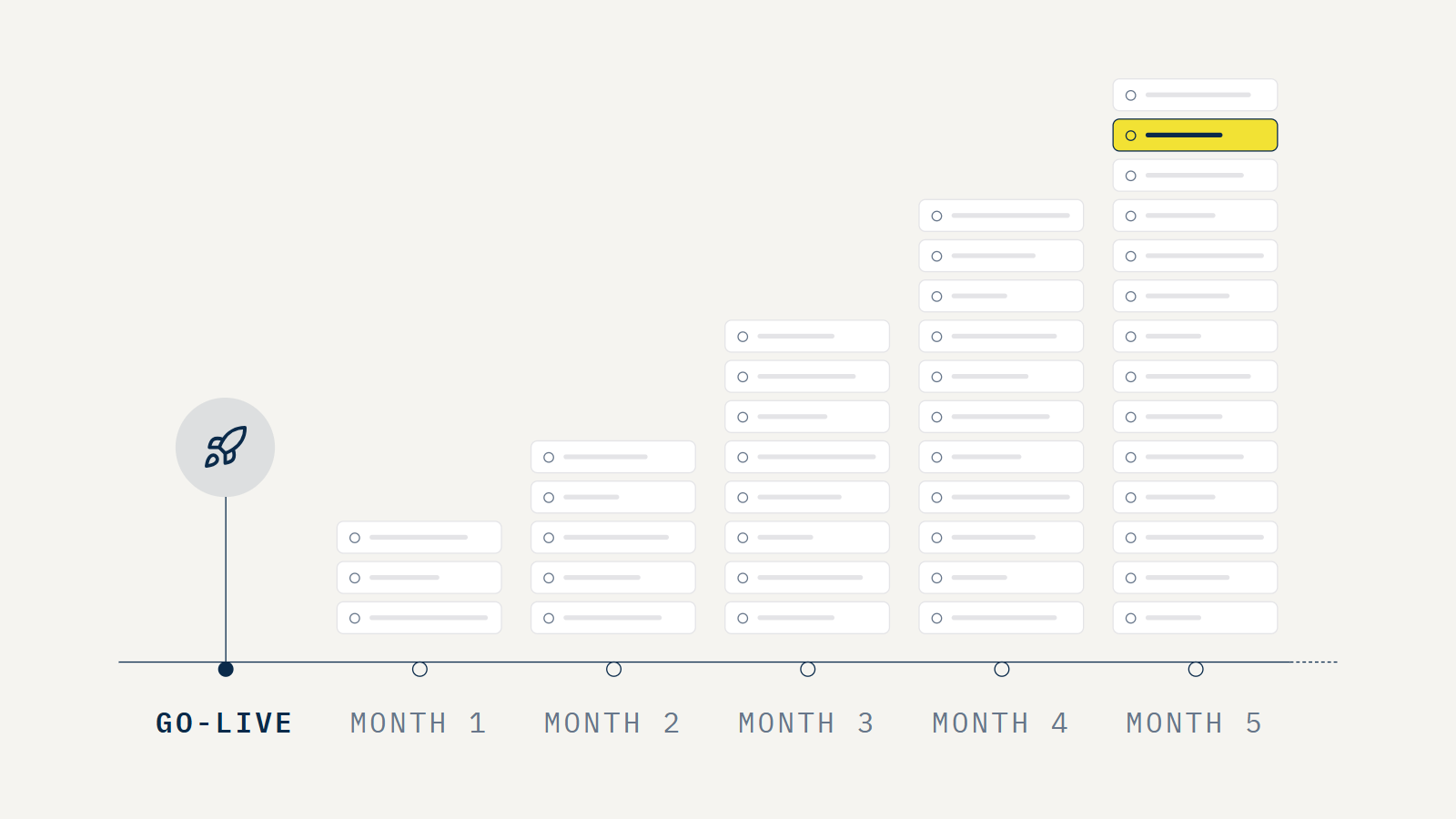
Go-live feels like the hard part. The scope is signed, the build is done and users are in. Then the requests start arriving: a customer asks for an export in a renewal call, the sales team needs a report to close a deal, and the feature you parked for phase two shows up in a competitor's release notes. Six months later the backlog is longer than it was at launch, and nothing new has shipped in months.
The person holding it all together is usually you. You write specs at night, chase quotes between sales calls and tell customers "soon" because you can't promise a date. You should be selling and running the business, not scaling the product.
This is the most common place for a product to stall. The idea was fine. What doesn't fit is the way software gets delivered after launch: projects are built for a fixed destination, and a live product needs a steady rhythm.
Three things that stall software delivery after launch
1. Every change becomes a quote
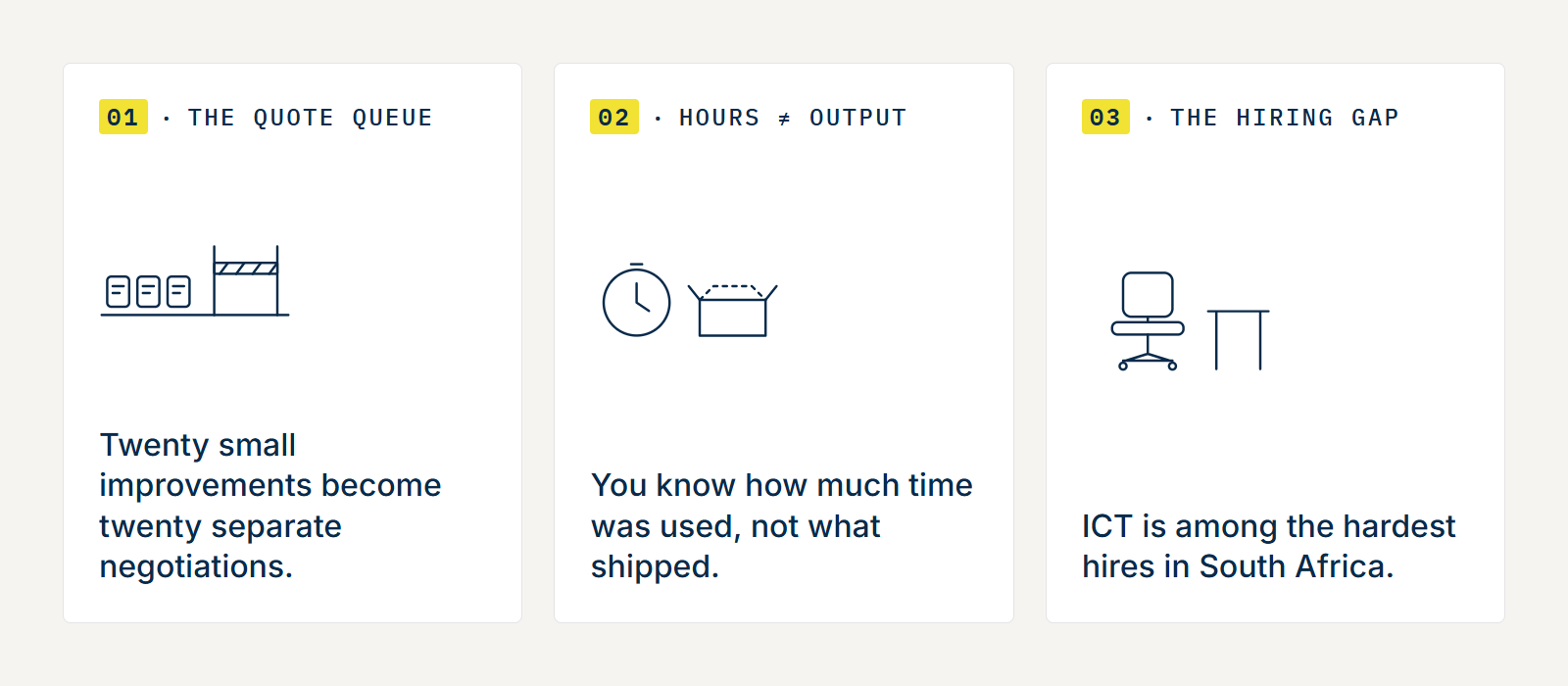
After launch, most businesses buy development one request at a time. Each request is scoped, quoted and approved separately, and we regularly see small changes wait weeks before work starts: a fix that takes a day to build spends three weeks in scoping, quoting and approval. The quotes can all be accurate and the waiting still costs you. A roadmap of twenty small improvements becomes twenty separate negotiations, and the business ends up rationing its own roadmap.
2. Hours are not output
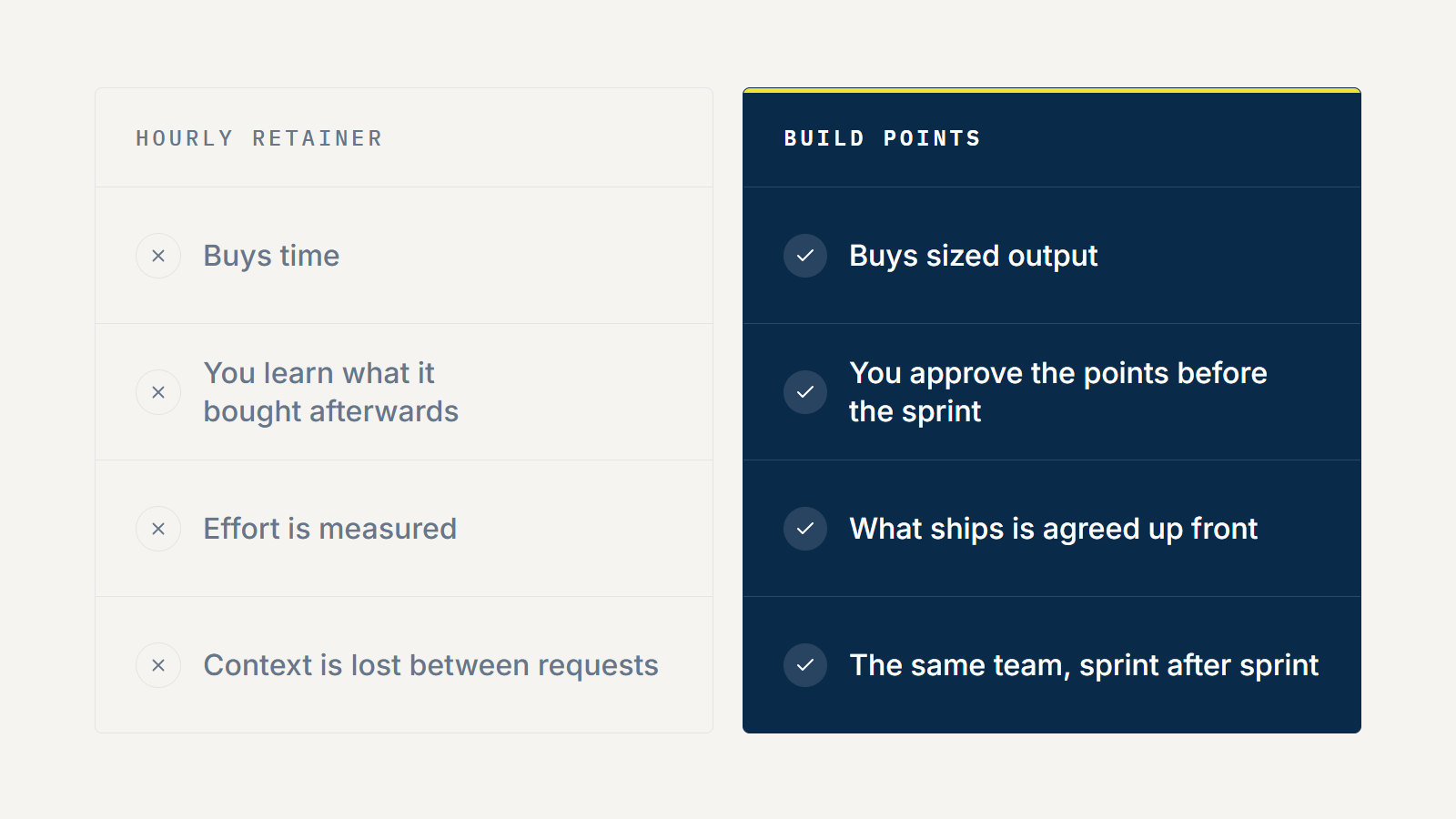
The usual fix is an hourly retainer: a block of developer time each month. It feels predictable, but it pays for effort and says nothing about delivery. Hours go on context switching, re-reading code nobody has touched in months, and meetings about what to do next. At the end of the month the invoice says 32 hours and the demo shows nothing.
We argued in The Velocity of Certainty that speed matters less than knowing what you will get. An hourly retainer gives you neither.
3. Hiring takes longer than the roadmap can wait
The other option is an in-house team, and in South Africa that is slow. ICT specialists are among the hardest hires in the country. In Xpatweb's preliminary 2026 Critical Skills Survey, a quarter of employers listed ICT specialists among the skills they struggle most to recruit, and 53% of all respondents said unfilled vacancies were constraining their operations (ITWeb, 2026). When the hire does land, one senior developer typically costs more each month than a whole managed product team. One developer is also a single point of failure: if they go on leave, fall ill or resign, the product stops moving again.
Even with a team in place, someone has to run it. The sprints need planning, the work needs sizing and testing, and the business has to stay close to what is being built. That someone is usually the founder. A managed team takes it off your plate. You don't recruit, onboard or manage anyone, and when someone is on leave or leaves, cover is already in place.
What keeps a product moving
Sooner or later the product moves faster than the team can keep up with, and the team becomes the bottleneck. Across the live products we support, the ones that keep shipping have four things in common.
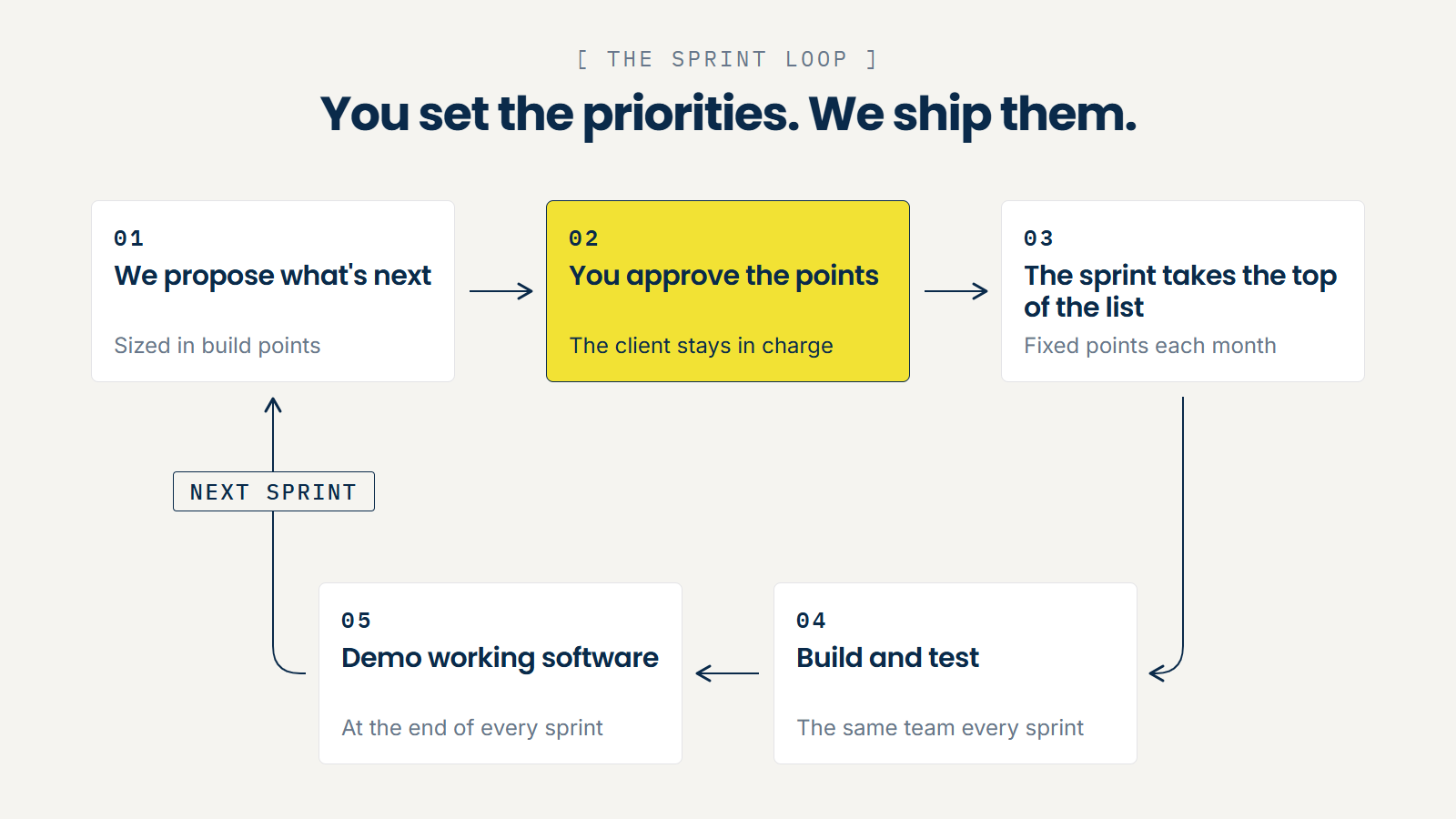
- The same team, sprint after sprint. A product owner, developers and testing who already know the data model, the users and the history of past decisions. Nothing has to be re-learned, so more of each month goes into building. Didn't build it with us? The first sprint is a handover: we work through the code, the data model and the backlog with you before sizing anything.
- Capacity bought as output, not hours. Work is sized in build points: a small change is one point, a larger feature two or three. A fixed number of points each month means you can plan around delivery. Every item is sized with you before the sprint starts, so you approve the points before any are spent.
- You set the priorities. You rank the work, and each sprint takes the top of your list and hands it back sized, shipped and demoed.
- Proof every sprint. Each sprint ends with a demo of working software, so you see the progress for yourself instead of reading about it in a report.
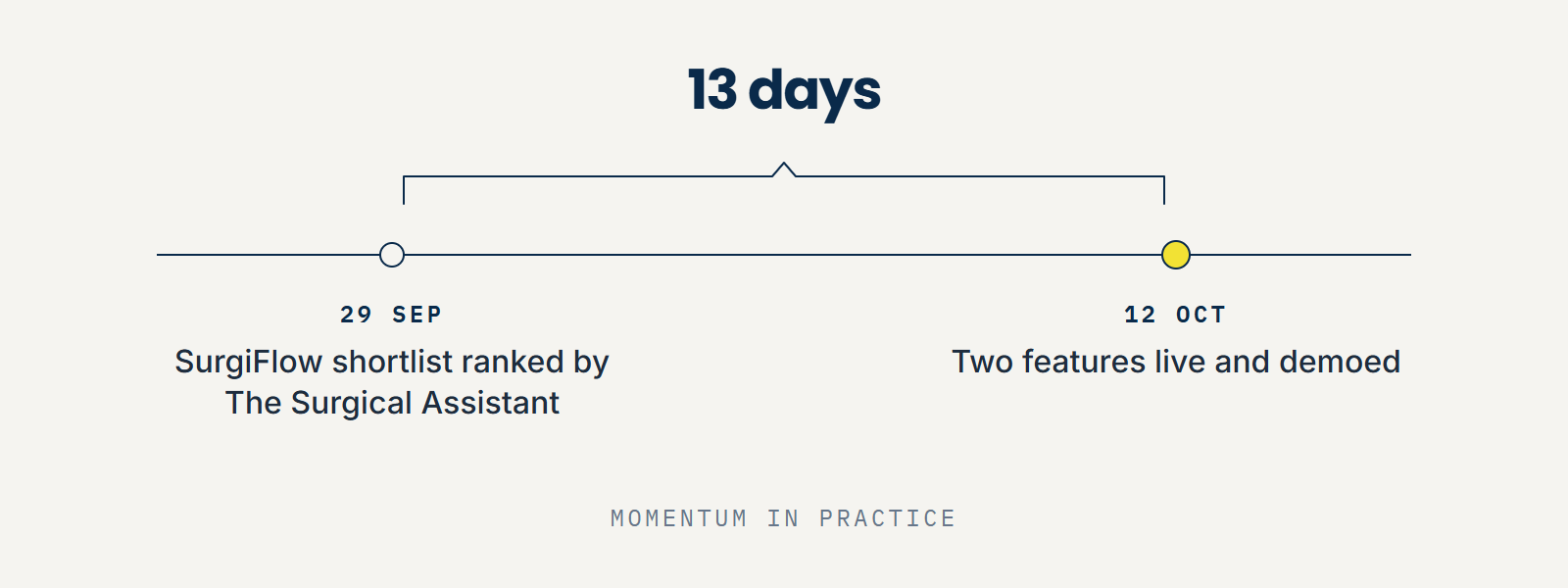
The Surgical Assistant ranked a shortlist of next features for its SurgiFlow platform on 29 September. Two of them, a geography dashboard and a document quick view, were live by 12 October and demoed in the sprint review like everything else.
SurgiFlow runs on Momentum Launch, our entry tier.
For less than we'd pay one senior developer, we have a whole product team: a product owner, developers and testing. We don't manage anyone or chase anything. We decide what matters most, and a fortnight later it's live and we're seeing it in the demo. Our time goes on surgeons and hospitals, not on running a build.
- Leroux Viljoen, Co-founder, The Surgical Assistant
AI has made building faster, but it is the standing team that understands your business.
When a monthly model is the wrong fit
- If the product is stable and rarely changes, you need support, not delivery, and paying for monthly build capacity you don't use is waste. That is what Sustain is for.
- If you are still shaping the idea, a delivery rhythm will only ship the wrong thing faster. Scope and cost it first with Context or Build. Our post on why 95% of AI projects fail covers what happens when teams skip that step.
- If the question is direction rather than throughput, you need strategic input as well as delivery. Innovation adds a senior partner to the same delivery team.
The model works best for a live product with a real roadmap, run by a business that wants to stay in charge of what gets built.
Keep the roadmap moving
A live product stalls when every idea has to fight its way through a quote, an hourly budget or a hiring plan. Replace those with a team that knows the product, a fixed amount of output each month and a demo every sprint, and the backlog starts to shrink. Every month the backlog waits is a month your customers wait too.
That is what Momentum is built for: a whole product team - product owner, developers and testing - for less than the cost of one senior hire, shipping your priorities every sprint for one predictable monthly fee. It starts from R50,000 a month for 8 build points (up to eight small changes, or a mix of small changes and larger features), with Growth and Scale for products moving faster. Unused build points roll over for a month, and we fix any defect in what we deliver.
See it in practice:
- SurgiFlow: a healthcare matching platform shipping every fortnight after launch
- Fleet control room console: a live operations console for a fleet business
- Teflon Connect: a fleet risk platform carried by one team across three platforms
Bring the backlog. We will tell you how fast it can move.
FAQs
Why do products stall after launch?
Because the work after go-live gets bought the same way the build was: one quote, one approval, one block of hours at a time. Every request queues, and nobody holds the whole product in their head between jobs.
How is this different from an hourly retainer?
A retainer sells you time and tells you afterwards what it bought. With build points, you agree what the sprint is aiming to ship before it starts, and you see it working in the demo at the end.
Should we hire our own developers instead?
Maybe, eventually. Hiring takes months in a tight market, one senior developer typically costs more than a whole managed team, and one developer is a single point of failure. A managed team starts on day one, with a product owner, testing and cover already in place.
What am I committing to?
There is a short minimum term, and after that you can change tiers or stop with notice. Everything we build lives in your own environment, so it is yours from day one. Book a call and we will walk you through the details.
References
- ITWeb. AI skills add pressure to South Africa's tech talent gap, reporting preliminary results of the Xpatweb Critical Skills Survey. 29 September 2026.