Speed is the headline. Certainty is what wins.
Most conversations about AI in software development start and end with speed of development:
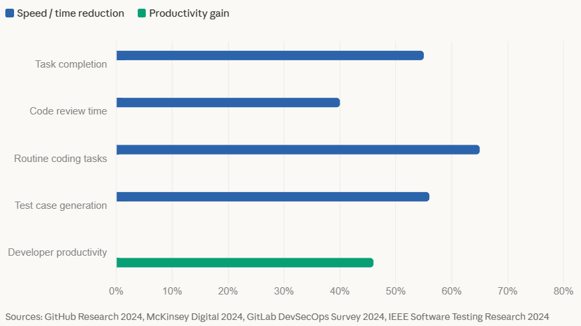
- developers using AI coding assistants complete tasks up to 55% faster
- time-to-market is compressed
- non-developers can use pro-code tools to deliver MVPs
These matter, but raw speed without reliability just accelerates risk.
What doesn't get reported as often:
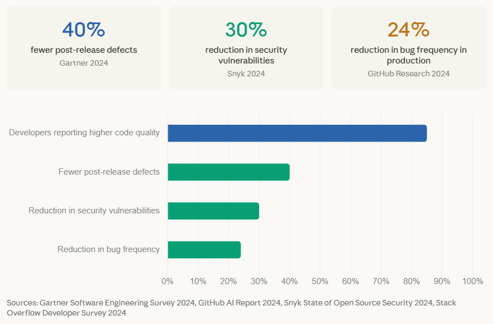
- teams using AI-assisted QA processes are seeing 40% fewer defects post-release
- code review time comes down by 30-50%
- testing is repeatable and picks up issues earlier
- security vulnerabilities are being caught earlier instead of patched later
The gains are spread across the entire delivery cycle, well beyond the build phase, and that is where we are focusing.
1. Focus on the Full Cycle, Not Just the Build
The principle is simple: shift left. In software delivery, shifting left means moving analysis, testing and security earlier in the process rather than catching problems at the end. AI makes this practical in ways it wasn't before.
At riivo, we're bringing AI into how we write code and also into how we take part in meetings, analyse requirements, architect systems, test builds, document technical aspects and review solutions. Getting this right is taking time. It needs process changes and internal tools built to support the workflow, so it isn't something you can just turn on.
That work is worth it, because this is where the certainty side of the equation lives.
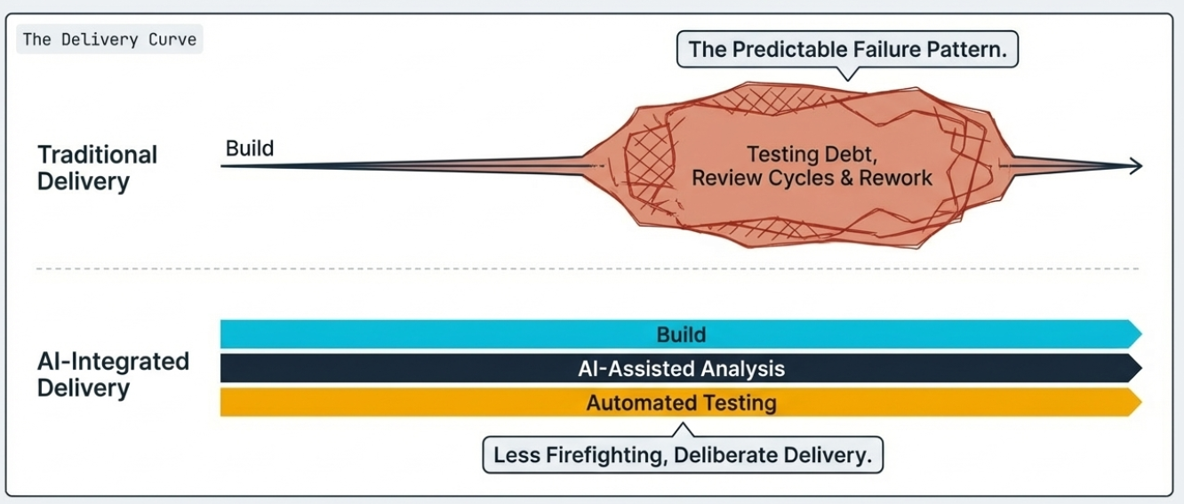
We post-mortem every build, and the same two contributors to failure keep appearing: misaligned scope and inadequate end-to-end testing. Both are addressable earlier in the process. Deploying AI there changes the back half of a project significantly, with less firefighting and more deliberate delivery.
Traditional delivery has a predictable failure pattern: the build moves fast, then slows under the weight of review cycles, misunderstandings, testing debt and rework. AI interrupts that pattern only if you apply it across the full cycle.
As more people gain the ability to build things quickly, the differentiator will be judgement: knowing where to apply AI, when not to, and how to govern what gets built. As we explored in The shifting Role of Agencies, using AI tools is necessary for survival, and the agencies that remain relevant are the ones who know how to wield them.
For innovators, this matters more than the headline speed number. Velocity is part of what they're investing in; a predictable outcome is the bigger part.
2. An Assumption Worth Challenging
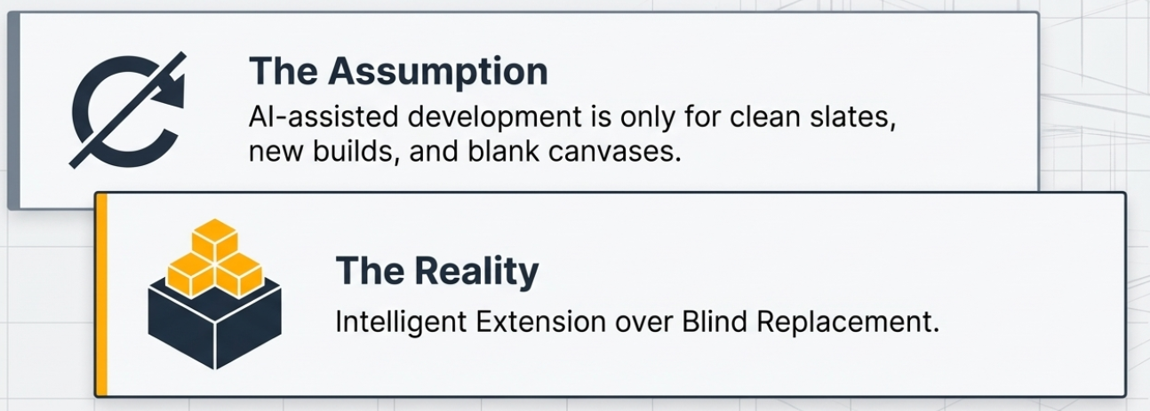
There's a widespread focus on AI-assisted development as primarily a greenfield story - clean slates, new builds, blank canvases. For some platforms, that's accurate. There are cases where the use case has shifted, the platform AI tooling hasn't kept pace, and the migration economics just make sense (why keep delivering 3 features per month when you could rebuild and deliver 20).
Power Platform is a different calculation entirely.
I've had clients question where things are heading, and my advice remains consistent: as a core system, Power Platform's benefits are significant. Microsoft's continuous infusion of AI into the build and user experience means it isn't standing still, and what it delivers is reliable.
What we're seeing in practice backs this up. We're already deploying fusion builds that augment and extend Power Platform by combining the flexibility of AI-assisted development with the enterprise strength of the platform itself. The result is tools rolling out significantly faster than was possible before, without compromising what clients already have working.
Microsoft's ecosystem is already enterprise-grade and AI-native. With 48 million users and access to a growing range of integrated AI models, it is a platform designed to be extended rather than replaced. Teams using Power Platform with Copilot are developing applications significantly faster than before.
The question we bring to these engagements isn't "should we rebuild this?" It's "how do we extend what's already working?"
Don't replace your core Power Platform system. Supercharge it.
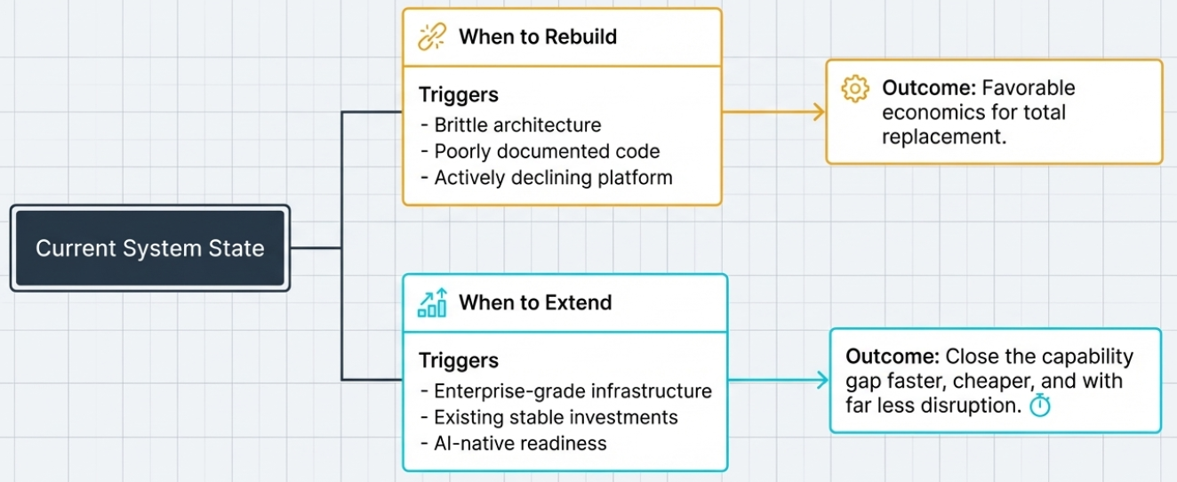
This sounds obvious until you're in a conversation where someone is considering a full platform migration because they assume their existing investment can't keep pace with AI-enabled alternatives. In most cases, that's the wrong frame. The capability gap can be closed through intelligent extension: faster, cheaper and with far less disruption than a rebuild. This connects directly to what we laid out in Same Destination, Just Faster: AI is the next layer of abstraction, not a reason to throw everything away.
There is a counterpoint: if the underlying architecture is brittle, poorly documented or built on a platform that's actively declining or closed, extension compounds the problem. Treat it as an architectural decision that needs an honest assessment of the existing system.
3. The Takeaway
The speed gains from AI-assisted development are real, but the entire development process needs to incorporate AI. The differentiation is in what happens around the speed: the quality of analysis, the rigour of testing, and the decisions about where and how to apply AI in the first place. That work is harder than it looks, and it takes longer to get right than most people expect.
For businesses running on Power Platform, the platform can keep up. The more valuable question right now is whether you have the right partner to extend it intelligently and supercharge what can be delivered.
Certainty travels a lot faster than unbridled development speed.
FAQs
Is AI-assisted development only relevant for new software projects? No, although it is a common assumption. AI tooling applies across the full delivery cycle, so it can be applied retrospectively. For existing core builds, Power Platform in particular, the opportunity is in using AI tools to extend what's already there instead of replacing it.
How does AI improve quality, not just speed? The productivity gains get the headlines, but the quality improvements are equally significant. Teams using AI-assisted testing and code review are seeing fewer post-release defects and significant reductions in review time. Here, speed and quality support each other.
When does it make sense to rebuild rather than extend? When the underlying architecture is genuinely unsustainable - poorly documented, built on a declining platform, or carrying so much technical debt that extension adds more complexity than it removes. That decision requires an honest assessment of the existing system rather than a default preference.
What makes Power Platform different from other low-code tools in this context? Power Platform is already AI-native and enterprise-grade. Microsoft's investment in Copilot capabilities means AI assistance is built into the development and client experience, not bolted on. That changes the extension economics significantly compared to platforms where AI integration is still emerging.